

Blog
How to Choose Between 3-Panel, 4-Panel, and 5-Panel Folding Screens

One of the simplest mistakes in screen selection is choosing the style first and the panel count second. In reality, the number of panels often determines whether the divider actually works in the room. A beautiful screen that is too short for the sightline problem, or too long for the placement, quickly feels awkward. That is why panel count matters so much.
The right choice usually comes down to width, flexibility, and how much of the room you are trying to interrupt. A 3-panel screen behaves differently from a 4-panel or 5-panel screen, even when the design language is similar.
Choose 3 panels when the space is tight
A 3-panel folding screen is often the easiest format for smaller rooms, studio layouts, bedside privacy, and narrower entry sequences. It gives separation without demanding too much floor width. That is one reason the Frosted Ribbed Glass Privacy Screen works well in apartments and compact layouts.
If your main concern is fitting a screen into a tighter plan, continue with Best Room Divider Ideas for Small Apartments.
Choose 4 panels when you need balance
A 4-panel screen is often the most versatile. It covers more width than a 3-panel piece but still remains easier to place than a 5-panel statement screen. This makes it a strong default for living rooms, open-plan zones, and many hospitality settings. If the divider needs to soften sightlines while still feeling substantial, 4 panels often hit the best balance.
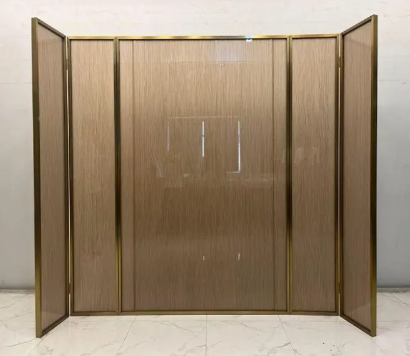
The Bronze Textured Glass Privacy Screen is a good example of how 4 panels can create stronger coverage without feeling overbuilt.
Choose 5 panels when the screen should shape the room
A 5-panel screen usually works best when the divider is not just solving a small sightline issue but actively shaping a wider part of the room. Larger living rooms, lobby-adjacent lounges, scenic backdrop uses, and dramatic decorative placements often benefit from this format. Five panels also help when the screen needs to carry more art or atmosphere across a broader span.
If the room calls for scenic presence as well as width, a piece like the White Mountain Landscape Folding Screen makes that logic very clear.
Panel count is not only about width
It is also about how the divider folds, angles, and sits in the room. More panels create more flexibility, but they can also make the piece visually stronger. Fewer panels feel cleaner and easier to manage, but they may not solve the room problem fully. This is why room photos and approximate width matter more than product names alone.
Use panel count to match the room problem
- 3 panels: compact layouts, bedside screening, tighter entries, studio apartments
- 4 panels: living rooms, open-plan separation, privacy with balance, most everyday residential needs
- 5 panels: scenic backdrops, larger rooms, hotel lounges, stronger focal and zoning roles
For placement-specific help, compare Living Room Screens, Entryway Screens, and Custom Screens.
When to move to custom
If the divider needs unusual width, repeated hospitality quantities, or a very specific relationship to architecture, it may be better to move beyond standard panel counts and use Request a Quote. Custom sizing is often worth it when the screen is a major visual element in the project.
Conclusion
The best panel count is the one that fits the real room problem. Three panels suit tighter spaces, four panels are often the most versatile, and five panels are strongest when the screen needs more presence and spatial reach. Getting that decision right usually matters more than choosing a motif first.
Recommended next steps: Compare the 3-panel Frosted Ribbed Glass, the 4-panel Bronze Textured Glass, and the 5-panel White Mountain Landscape Screen.
Frequently Asked Questions
Is a 3-panel screen enough for a living room?
Sometimes, but it depends on width and placement. In many living rooms, 4 panels offer a better balance of coverage and flexibility.
When is 5 panels too much?
It can be too much in compact rooms or narrow entries where the screen starts to dominate circulation.
What is the safest default?
Four panels are often the safest default because they suit many room types without feeling too small or too expansive.
Continue Reading
If the room is taller and more open than a standard plan, continue with Loft Divider Screen Ideas.
